
Every few months, someone sends us a link building offer that sounds too good to be true. Fifty “high authority” backlinks, DA 40 and up, delivered within a week, all for less than the price of a nice dinner out.
In this article13 min read · 10 sections
- What are PBN links?
- How does a private blog network work?
- Why do people still buy PBN links?
- What does Google say about PBN links?
- How do you spot PBN links in your backlink profile?
- What should you do if you find PBN backlinks?
- Why do reputable agencies avoid PBN links?
- What are the safer alternatives to PBN links?
- FAQs about PBN links
- So, are PBN links ever worth it?
We don’t even need to open the sample sheet anymore. It’s almost always PBN links.
PBN links are backlinks from a private blog network, which is a bunch of websites secretly run by one person for one reason: to push another site up Google. They go against Google’s spam policies, the rankings they bring usually don’t stick and cleaning up after them costs a lot more than the package ever did.
If you’ve ever wondered why one agency offers you 100 backlinks for $200 while another wants ten times that for twenty links, this is most of the reason. Below, we get into what these links are, how to check your own site for them and why we turn these jobs down.
What are PBN links?
PBN is short for private blog network. Picture ten, twenty, sometimes a hundred websites that all belong to the same person but are dressed up to look like they have nothing to do with each other.
Any link coming from one of those sites is a PBN link. Some people call it a PBN backlink. Same thing.
The site getting all the links is called the money site. The sites doing the linking are called nodes, satellites or just “the network.” From the outside, each one looks like a normal blog, with a homepage, a few categories and some posts. But nobody is really writing for readers. The posts are only there so the links have something to sit inside.
What is PBN in SEO?
In SEO terms, a PBN is a way to fake backlinks instead of earning them. Google still looks at links from other websites when it decides which pages to rank, a bit like counting votes. A PBN owner simply prints their own votes.
Not every network of websites is a PBN
This is where people get confused. A car brand linking to its dealer sites, or a media house linking between its own magazines, isn’t running a PBN. Nobody is hiding anything and the links are there to help people find things.
A PBN is different because the ownership is hidden on purpose and the only real job is rankings. If the sites wouldn’t exist without the links, you’re looking at a PBN.
How does a private blog network work?
It all comes back to how Google uses links. Every link to a page counts a bit like a vote and votes from trusted sites count for more. PBN builders try to fake those votes in bulk and the recipe hasn’t changed much in ten years:
- Buy expired domains. When a business shuts down or forgets to renew its website, the domain goes up for auction and the backlinks it earned over the years still point to it. That’s authority already baked in.
- Put a blog on each one. Usually WordPress, a free theme and a handful of articles that are spun, scraped or churned out by AI. Just enough to look alive.
- Hide the connections. Different hosting companies, different themes, privacy protection on the domain registration. The idea is to make ten sites run by one person look like ten sites run by ten people.
- Link to the money site. Often with exact match anchor text like “best dentist in London.” A real editor writing a real article would almost never link that way.
Most people who use PBN links never build a network themselves. They buy placements on someone else’s and that’s what a lot of those cheap “guaranteed backlink” packages actually are. It also means the network isn’t very private, because the same sites are selling links to dozens of other buyers.
Why do people still buy PBN links?
Because sometimes they work, at least for a while. We won’t pretend otherwise. A new site can climb a few spots after a batch of PBN backlinks and if you’re in a crowded space like real estate or online courses, a few spots feels like a lot.
Most of the pull comes down to three things:
- Speed. Getting a link from a real publication can take weeks of pitching and follow ups. A PBN seller can place twenty in a few days.
- Control. You choose the anchor text, the page and the timing. Nobody else gets a say.
- Price. On paper, a PBN link looks much cheaper than a mention on a respected site.
The trouble is that the boost rarely lasts. When it ends, it can take a lot more down with it.
What does Google say about PBN links?
You won’t find the word “PBN” anywhere in Google’s rules. It doesn’t need to be there. Google’s spam policies describe link spam as links made mainly to manipulate rankings and they list buying or selling links for ranking purposes, excessive link exchanges and automated link building as examples. A PBN usually breaks more than one of these.
In March 2024, Google also added a separate policy on expired domain abuse. It covers buying old domains and filling them with low value content to manipulate rankings, which is exactly how most networks are built.
Google has also become a lot better at catching this. In its webspam report for 2022, Google said it had trained its AI system, SpamBrain, to find both the sites building spammy links and the sites set up to pass them along. That helped it detect 50 times more link spam sites than its previous link spam update did.
The message hasn’t changed since. In an April 2026 post on Bluesky, Google’s John Mueller repeated that if Google’s systems see a site linking out in a way that goes against its policies, Google may ignore all of the links going out from that site.
So if Google catches PBN links pointing at your site, you’re usually looking at one of two outcomes:
- The links get ignored. This is the more common one these days. Google quietly stops counting them, the ranking boost goes away and so does the money you paid. A lot of site owners don’t notice until the traffic graph starts sliding.
- You get a manual action. Someone at Google reviews your site and an “unnatural links to your site” message turns up in the Search Console. Rankings can fall hard. To get out, Google asks you to remove the links, disavow the ones you can’t remove and send a reconsideration request. It isn’t a quick process.
One wastes your budget. The other can undo years of work.
How do you spot PBN links in your backlink profile?
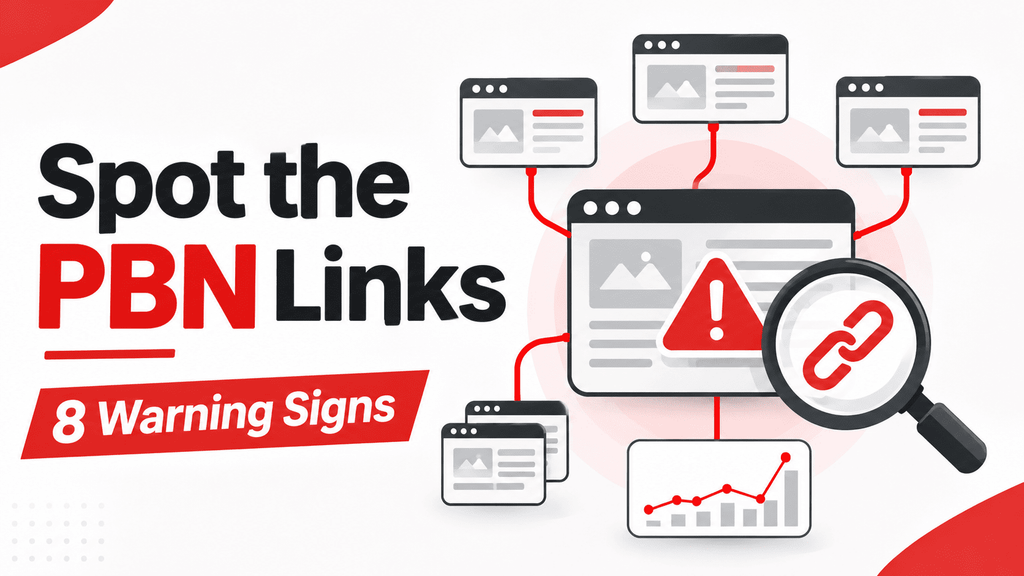
You don’t need to be an SEO person to do a first check. Export your backlinks from Ahrefs, Semrush or the Links report in Google Search Console, pick ten or fifteen of the linking sites and actually open them in your browser. You’d be surprised how quickly PBN links give themselves away.
These are the signs we look for:
| Footprint | What it looks like | How to check |
| Thin, random content | One post about crypto, the next about kitchen tiles, then one that happens to mention your brand | Read three or four posts on the site |
| Nobody reads it | No comments, no social accounts, no real names on the about page, almost no traffic | Check its estimated traffic in your SEO tool |
| The domain used to be something else | It was a bakery in 2019 and a “lifestyle magazine” now | Look it up on the Wayback Machine |
| Anchor text that’s a little too perfect | “Best SEO agency in New York” instead of your brand name or a normal phrase | Check the anchor text column in your backlink report |
| It links out to everyone | Dozens of unrelated businesses get a link, but hardly anyone links back | Compare its referring domains with the sites it links to |
| Sites that look like siblings | Same hosting or IP address across several linking sites | Run the domains through a reverse IP lookup |
| Same setup everywhere | Same theme, same plugins, sometimes the same Google Analytics ID | View the page source and compare tracking codes |
| Links that arrive all at once | Twenty new referring domains in one week, then nothing | Look at the new referring domains graph over time |
One of these on its own doesn’t mean much. Plenty of small, honest blogs are a bit thin or run on cheap hosting. It’s when three or four show up together, across several sites, that we start digging.
You also won’t catch everything this way. Some PBN owners block SEO tools from crawling their sites, so those links never appear in Ahrefs or Semrush at all.
How we check a suspicious backlink at Mystoria
When a new client comes to us, we run every doubtful linking domain through the same routine. It takes a few minutes per site and all you need is a spreadsheet:
- Read it like a customer. Open the page and ask yourself if anyone in this industry would actually visit this site.
- Check the traffic trend. Look at its organic traffic over the past year. Big authority numbers with almost zero traffic is one of the clearest red flags there is.
- Look at the neighbours. See who else it links to. If your link sits between a casino and a loan app on a home decor blog, that tells you plenty.
- Check its past. Put the domain into the Wayback Machine and see what it used to be.
- Read the anchor text. If the same money keyword keeps turning up across different sites, someone planned it.
- Compare the suspects. Line up the flagged sites and compare their hosting, theme and tracking codes.
If a domain fails three or more of these, we treat it as part of a network. We don’t build anything on it and we mark it in the audit so the client knows exactly where it came from.
What should you do if you find PBN backlinks?
First, don’t panic. And please don’t upload a giant disavow file the same afternoon.
If you never bought these links, the best move is usually to leave them alone. Spammy sites link to normal businesses all the time, sometimes just to make their own link profile look more natural. Google says its systems are designed to neutralize the impact of unnatural links, so links like these usually just get ignored.
If you (or a previous agency) paid for them, stop any ongoing link packages first. Then think about timing. If those links are still holding up some of your rankings, removing them may cause a dip for a while. We think that’s worth it for a site you can trust in the long run, but it’s better to know it’s coming.
If you’ve received a manual action, then you do need to act. Ask site owners to take the links down where you can, disavow the rest with Google’s disavow tool, keep a record of everything you did and send a reconsideration request.
And go easy with that disavow tool. Google’s own help page for the disavow tool calls it an advanced feature and warns that using it incorrectly can hurt how your site performs in search. If you’re not sure which links are actually harmful, get someone to go through them with you before you upload anything.
Why do reputable agencies avoid PBN links?
Even if a PBN worked perfectly for six months, it would still be a bad deal for the client. Here’s why we stay away:
- The client carries the risk, not the agency. When rankings crash, it’s your traffic and leads that disappear. The agency that built the links loses one account and carries on.
- You might be paying for nothing. If Google decides to ignore the links, the budget is gone and nobody refunds that.
- It gets in the way of real growth. Every dollar spent on fake links is a dollar that didn’t go into content, PR or partnerships that keep working for years.
- Cleaning up is painful. Fixing a messy link profile is slow, boring work and there’s no guarantee you’ve found every bad link.
- It’s a trust problem. If an agency is happy to hide where your links come from, what else are they happy to hide?
What should you ask an SEO agency about link building?
If you’re speaking to an SEO agency right now, ask them these five things on the call:
- Where exactly will my links come from? Can I see examples from your current clients?
- Do you own or control any of the sites you place links on?
- How do you decide the anchor text?
- Will I get a full list of every link, with URLs?
- What happens to those links if we stop working together?
A good agency will answer without any fuss. If you hear things like “our private inventory,” “partner properties” or “that’s proprietary,” ask them straight out whether they mean a PBN.
What are the safer alternatives to PBN links?
Real links take longer. There’s no way around that. But they add up and one link from a respected site in your industry can keep sending traffic and trust for years.
This is what we focus on instead:
- Make something people want to reference. Original data, a simple calculator, a survey of your industry or a guide that’s actually useful. Journalists and bloggers link to sources, not to sales pages.
- Do proper digital PR. Pitch stories and expert comments to the publications your customers read. That often means trade magazines, regional news sites and niche newsletters, not only the big national papers.
- Guest post only where there are real editors. If a site will publish anything for a fee, the link isn’t worth much.
- Use the relationships you already have. Suppliers, distributors, industry associations, event organisers and local business groups often have partner or member pages.
- Claim the links you’ve already earned. Find sites that mention your brand without linking, or that link to a broken page on your site and ask them to fix it.
- Tidy up your internal links. It won’t replace backlinks, but it helps the authority you already have reach the pages that need it.
None of this is as quick as buying a package. But a year from now, every link will be yours and none of them will keep you up at night.
FAQs about PBN links
What is a PBN link?
It’s a backlink from a website that belongs to a private blog network. The site is there mainly to pass authority to another website, not to help readers.
Do PBN links still work in 2026?
Sometimes, for a short while. Google is much better at spotting link networks now, so most of the time the links just stop counting.
How can I tell if my agency is using PBNs?
Ask for the full list of links they’ve built and open some of them yourself. If the sites look thin, have nothing to do with your industry and don’t seem to have any readers, ask the agency how they got those placements.
So, are PBN links ever worth it?
Not for a business that plans to be around in five years. PBN links can move your rankings for a few weeks, but they leave you open to wasted money at best and a Google penalty at worst.
If you’re not sure what’s sitting in your backlink profile, start with the quick check above. A few minutes in a spreadsheet will tell you more about your links than any authority score.